
Concrete coatings for Hamilton County homes
Epoxy Flooring in Carmel, IN
Garage, basement and shop floors prepared for Indiana salt, humidity and freeze-thaw, starting with a full diamond grind.
- Free on-site estimate with a slab moisture test
- Itemized written quote that names every coat
- Full diamond grind on every floor we coat
Coated Concrete for a Fast-Growing Suburb
Epoxy flooring in Carmel is mostly a garage job. The city grew from 6,691 people in 1970 to 99,757 at the 2020 census, and census survey data summarized by Point2Homes puts the median year built for Carmel housing at 1998. That means a lot of attached two- and three-car garages with slabs that are 20 to 35 years old. They are past the new-concrete stage, they have taken a couple of decades of winter salt, and many still have the bare, dusty finish they came with.
What central Indiana winters do to a garage slab
Indianapolis averages about 25.5 inches of snow a season under the 1991 to 2020 normals, and its January mean temperature is 28.5°F. That is cold enough for plenty of salting and mild enough for the slab to freeze and thaw over and over. Carmel also has a lot of road to treat: the city built 155 roundabouts between 1997 and 2025, and in early 2015 the local paper Current reported the city had 5,600 tons of salt stockpiled for the winter. That salt rides home in the wheel wells and melts onto your garage floor. A literature review written for the South Dakota DOT by the Michigan Tech Transportation Institute found that sodium chloride causes severe scaling in concrete under freeze-thaw cycling, and that magnesium and calcium chloride also attack the cement paste chemically. A sealed resin floor keeps that brine on the surface, where a squeegee can move it out the door.
Newer homes still need real prep
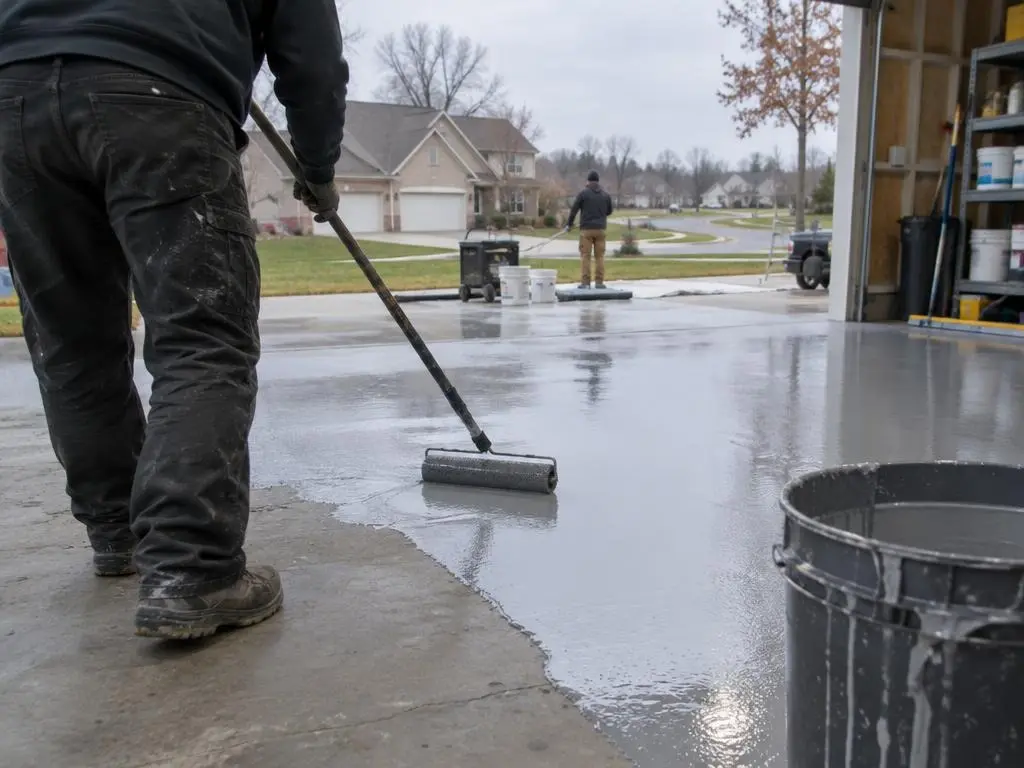
A 1998 or 2010 slab looks smooth, but smooth is a problem for coatings. Dense, troweled concrete gives resin very little to grip, and some garages were sealed or painted along the way. We diamond grind every floor, edges included, so the base coat bonds into open concrete. Then we fill cracks, repair spalls near the door and degrease oil spots. If the house is brand new, we wait until the concrete has cured long enough for the product we are using.
Basements and wet soil
Below grade, moisture matters more than salt. USDA soil series descriptions list Indiana till-plain soils such as Crosby as somewhat poorly drained, with a perched water table 0.5 to 2 feet down in winter and spring. Brookston soils, which USDA calls poorly drained, are widespread in Indiana too. Summers are humid here as well. That combination can push vapor up through a basement slab or cause a cold floor to sweat. We test the slab before recommending a basement system and use a moisture-tolerant primer when the readings call for one. The American Lung Association notes that every Indiana county falls in EPA radon Zone 1 or 2, so we suggest a radon test before you finish a basement. A floor coating does not replace mitigation.
Systems we install
- Garage floor epoxy: a bonded epoxy base with a tougher topcoat, the standard choice for daily parking.
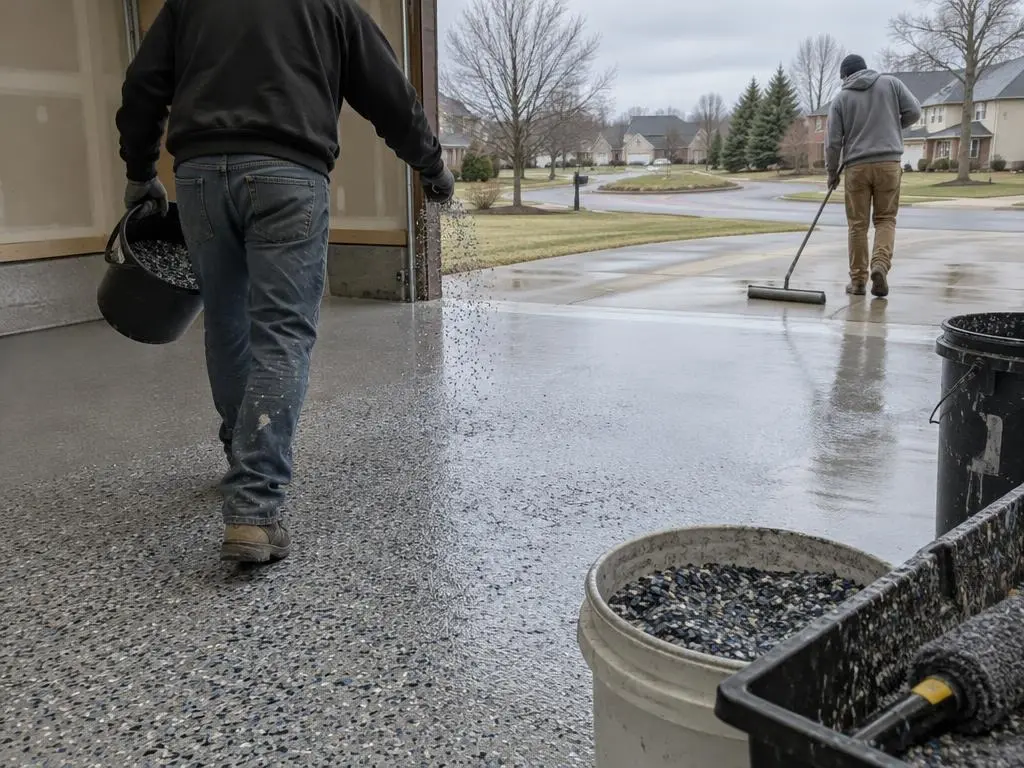
- Flake floors: vinyl chips broadcast into the base coat. They hide salt film and dust and add grip.
- Polyaspartic coatings: a faster cure and UV-stable finish, useful for garages that face west or sit with the door open.
- Metallic epoxy: poured, swirled color for basements, bars, gyms and dealerships.
- Basement floor systems: moisture-tested and primed for below-grade slabs.
- Commercial floors: thicker builds for offices, retail, clinics and light industrial space along the Meridian Corridor and beyond.
What is in a typical garage job
- A walkthrough to agree on what gets moved and when
- Moisture testing and a check for cracks, pitting and old sealers
- Full diamond grinding with vacuum dust collection
- Crack, spall and control joint repair
- Base coat, flake or color layer, and a clear topcoat
- Written cure times and a winter cleaning routine
Where We Work
Carmel is home base, and we work throughout Clay Township, which the city has covered entirely since annexing Home Place in 2018. We also coat floors in Westfield, Fishers, Noblesville, Cicero, Sheridan and Arcadia in Hamilton County; Zionsville, Whitestown and Lebanon in Boone County; McCordsville, Fortville and Greenfield in Hancock County; Pendleton, Lapel and Anderson in Madison County; and Indianapolis, Lawrence, Speedway, Meridian Hills and Williams Creek in Marion County, plus Brownsburg to the west. Floors vary across that area. Westfield and Whitestown have added thousands of new homes in the last decade, while Meridian Hills, Speedway and older parts of Anderson and Greenfield have houses and garages from the early 1900s onward. Each town page covers what we know about homes there.
- Epoxy Flooring in Carmel, IN
- Epoxy Flooring in Indianapolis, IN
- Epoxy Flooring in Westfield, IN
- Epoxy Flooring in Fishers, IN
- Epoxy Flooring in Noblesville, IN
- Epoxy Flooring in Zionsville, IN
- Epoxy Flooring in Whitestown, IN
- Epoxy Flooring in Cicero, IN
- Epoxy Flooring in Sheridan, IN
- Epoxy Flooring in Arcadia, IN
- Epoxy Flooring in Lebanon, IN
- Epoxy Flooring in McCordsville, IN
- Epoxy Flooring in Fortville, IN
- Epoxy Flooring in Lawrence, IN
- Epoxy Flooring in Meridian Hills, IN
- Epoxy Flooring in Williams Creek, IN
- Epoxy Flooring in Speedway, IN
- Epoxy Flooring in Brownsburg, IN
- Epoxy Flooring in Greenfield, IN
- Epoxy Flooring in Pendleton, IN
- Epoxy Flooring in Lapel, IN
- Epoxy Flooring in Anderson, IN
Common Questions
How much does epoxy flooring cost in Carmel?
HomeGuide lists installed epoxy at about $4 to $10 per square foot nationally, or $1,600 to $5,800 for a two-car garage. Polyaspartic and full flake systems usually run higher, and grinding off an old coating or repairing salt damage adds to the total. We give you a written price after seeing the floor.
How much does a 12x12 epoxy floor cost?
A 12x12 floor is 144 square feet. At HomeGuide's $4 to $10 per square foot that is roughly $580 to $1,440, but small rooms often cost more per foot because setup, grinding and travel are the same as on a bigger job. Many installers have a minimum charge, so we quote small floors individually.
What are the disadvantages of epoxy flooring?
Epoxy needs a dry, clean, ground slab, and it can lift if moisture or oil is trapped under it. Standard epoxy cures slowly, and HomeGuide says solid epoxy takes about seven days to fully cure. It can also yellow in sunlight without a UV-stable topcoat and get slick when wet without texture. We plan for each of those before the first coat.
Is epoxy good for concrete floors?
Yes, when the slab is sound and prepared. A bonded resin coating seals the surface against oil, salt brine and dust and makes the floor much easier to clean. It will not fix a slab that is heaving or leaking, and we say so if we find that.
How soon can I park on a new garage floor?
It depends on the system and the temperature. Bob Vila's coating guide says polyaspartic floors usually take vehicles after about 24 hours, while epoxy needs about three days. We give you a time for your floor based on the product and the conditions that day.
Is epoxy flooring good for restaurants and businesses?
Resin floors are common in kitchens, clinics, retail and light industrial space because they are seamless and easy to clean. Commercial floors usually need a thicker 100% solids build, and HomeAdvisor lists industrial coatings at $12 or more per square foot. We look at traffic, chemicals and cleaning methods before choosing the system.
Can you coat a garage floor in the winter?
Sometimes. Every resin has minimum slab and air temperatures for curing, and an unheated Carmel garage in January is often below them. We check the slab temperature and may heat the space, or we schedule the job for a warmer stretch.
Why Homeowners Call Epoxy Flooring Carmel
Grinding on every job
We diamond grind the whole slab and every edge. Acid etching alone leaves sealers and weak surface concrete behind.
A moisture reading first
Garages and basements are tested before we recommend a system, because vapor under a coating is a common reason it blisters.
Finishes picked for salt and sun
Texture keeps wet floors from getting slick, and UV-stable topcoats go on floors that see daylight through an open door.
An itemized quote
Square footage, prep, each coat and the total are written down. Scope changes are written up and approved by you first.
Epoxy Flooring Services in Carmel
Six concrete coating services for the garages, basements and commercial spaces we see most often around Carmel and Hamilton County.
Garage Floor Epoxy
A bonded, sealed garage floor for 20- and 30-year-old Carmel slabs that have seen years of salt and tire traffic.
Learn more →Flake Epoxy Floors
Colored vinyl chips broadcast into the base coat for a textured garage or utility floor that hides salt film and dust.
Learn more →Polyaspartic Floor Coating
A fast-curing, UV-stable coating that lets you back into the garage sooner and holds its color in sunlight.
Learn more →Metallic Epoxy Floors
Poured, swirled epoxy with metallic pigment for basements, home bars, gyms and dealerships.
Learn more →Basement Floor Epoxy
Moisture-tested coatings for unfinished and finished basement slabs, storage rooms, gyms and laundry areas.
Learn more →Commercial Floor Epoxy
Heavier resin systems for offices, retail, clinics, kitchens and light industrial floors along the Meridian Corridor and beyond.
Learn more →Get an Epoxy Flooring Estimate
Free on-site estimates in Carmel and across Hamilton County.